

Rubber vs EVA car mats: which are better for practicality, safety, and savings?
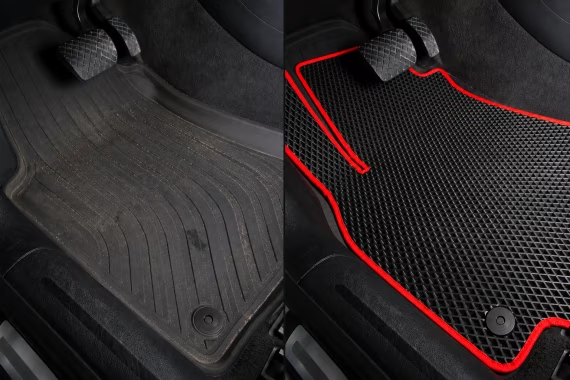
Car mats may seem like a minor detail, but they take on dirt, sand, moisture, and road chemicals every day. A high-quality floor covering not only keeps the interior clean but also affects comfort and even safety, because a shifted mat can interfere with the pedals. Today, two popular options are rubber and EVA. Which is better in practice: EVA mats or rubber mats? Let’s look at their features to understand which option is right for you.
EVA Mats or Rubber Mats, Time-Tested Solutions
Rubber mats are well known to experienced car owners. They have earned their popularity thanks to their simplicity and durability. In high-quality models, the raised edges hold water and dirt, while the dense structure prevents moisture from reaching the car floor. Such mats can be removed, washed with a hose, and put back in place — with minimal effort.
There are also disadvantages. Universal models do not always follow the shape of the floor perfectly, leaving gaps. Cheap rubber can produce an unpleasant smell and become stiff in cold weather. Rubber mats are heavy, so shaking them out quickly is not always convenient. Still, they are almost indestructible: for winter and the off-season, this is a practical option.
Who are they suitable for? For those who value time-tested solutions, are ready to deal with the weight of the mats, and are not chasing a refined appearance.
EVA Mats or Rubber Mats: The Practical Advantages of Ethylene Vinyl Acetate
EVA is a lightweight, durable, and flexible polymer widely used in the footwear and sports industries. Its honeycomb structure makes these floor coverings fundamentally different from rubber ones. Instead of spreading across the surface, water and dirt collect in the cells, keeping the interior dry and clean.
The main advantages of EVA mats:
- Lightweight and easy to maintain. The mats can be removed with one hand, shaken out, or rinsed with water — and they are ready to use again.
- No unpleasant odor. Unlike traditional rubber, EVA does not release sharp chemical smells.
- Flexibility in any weather. The material does not become stiff in the cold and does not deform in summer.
- Custom fit. These mats are often made according to patterns for a specific car model, taking curves and mounting points into account. This improves safety: the covering does not slide around or move under the pedals.
- More design options. A colored base and decorative edging make it possible to choose a style that matches the car interior.
As for the disadvantages, EVA mats can be harder to clean if the dirt has dried, and in case of heavy soiling, it is better to rinse them with water rather than simply shake them out. They are more expensive than mass-produced rubber models, but the price difference is small compared to the benefits in durability, comfort, and safety.
Who are they suitable for? For those who want a lightweight, stylish, and modern floor covering and are ready to pay a little more for comfort and convenience.
What to Choose: EVA Mats or Rubber Mats
There is no single answer — it all depends on driving conditions. If you often drive on muddy roads or deal with a lot of snow and road chemicals in winter, high-quality rubber mats will be a reliable solution. They withstand heavy use and do not require special care.
But if lightness, neatness, and a precise fit are important to you, it is worth taking a closer look at EVA. This is a versatile option for year-round use: in spring and autumn it holds moisture, in summer it remains flexible, and in winter it does not become stiff or slippery. It is also a great way to refresh the interior with color and shape.
The ideal approach is to choose mats based on the season and your driving style. Many car owners use rubber mats for winter and the off-season, and EVA mats for summer and dry weather. But if you want one set “for everything at once,” custom EVA mats with high edges will handle this task better than most universal rubber alternatives.
Which Is Better: EVA Mats or Rubber Mats — The Financial Side
Which is better, EVA mats or rubber mats from a financial point of view? An interesting question, so let’s break it down.
At first glance, EVA mats may seem like an expensive choice: their price is higher than that of standard rubber models. But if you look not only at the initial purchase, but at several years of use, the situation changes — and in favor of EVA.
First, durability. High-quality EVA mats can easily last 4–6 years, without cracking, wearing out, or losing their shape even with temperature changes. Rubber, on the other hand, often becomes stiff in the cold, may deform, and can “age,” which means the mats may need to be replaced sooner.
Second, interior protection. EVA mats, especially custom-fit ones, follow the floor contours more accurately and stay fixed in place better. Dirt and water do not seep under the covering, which reduces the risk of corrosion and unpleasant odors. Floor repair or professional interior cleaning costs much more than the price difference between EVA and rubber.
Third, saving time and effort: the honeycomb structure of ethylene vinyl acetate does not require regular deep cleaning. Cleanliness under your feet can be restored with a simple shake-out that takes just a minute. Rubber models more often require brushes and special cleaning products, which over time become extra expenses and wasted time.
In the long run, EVA mats are more cost-effective: you pay more at the start, but save on replacement, maintenance, and car care. It is an investment in comfort, cleanliness, and the condition of your vehicle — and therefore in your own peace of mind.
Which Mats Are Better — Rubber or EVA: A Short Conclusion
Rubber mats are a strong and reliable classic, but EVA is a lightweight and modern upgrade that pays off through comfort, durability, and long-term savings. If all you need is low-maintenance practicality, rubber will do. But for those who value style, safety, and convenience, EVA mats are worth considering. Whatever you choose, EVA mats or rubber mats, do not forget about the fit: a perfectly tailored floor covering is always safer and more convenient in everyday use.